
Priority problem
Campaign-first thinking
Advertising cannot rescue a weak offer, unclear audience or page that breaks the message. The commercial path needs to be understood first.
Google Ads · Meta Ads · Paid acquisition
GrowthLabs plans advertising as one connected system: customer demand, audience, offer, creative, campaign structure, landing experience, tracking, lead handling and the learning loop that improves the next decision. Run campaigns with a clearer view of qualified action, not only clicks, views or cheap leads.
Share the offer, landing page, target market, active platforms, approximate monthly media spend, primary conversion and tracking status.
Advertising Agency in Nepal / Decision summary
A useful advertising agency in nepal engagement connects the immediate business constraint to the capability, customer journey and measurable outcome that can address it.
Priority problem
Advertising cannot rescue a weak offer, unclear audience or page that breaks the message. The commercial path needs to be understood first.
Connected capability
Capture active demand through paid search and PPC campaigns built around responsible keyword selection, structure, negative keywords, relevant copy, suitable landing pages and conversion tracking.
Working outcome
Find whether the next paid-growth constraint is targeting, creative, offer, landing experience, tracking or follow-up.
Start with context, not a package. Share the current website, offer, audience and result that needs to improve.
Request a Google & Meta Ads reviewThe paid-growth objective
Find whether the next paid-growth constraint is targeting, creative, offer, landing experience, tracking or follow-up.
Why paid campaigns struggle
Advertising cannot rescue a weak offer, unclear audience or page that breaks the message. The commercial path needs to be understood first.
More reach is not automatically better. Targeting should reflect who is likely to value, afford and act on the offer, not merely who is cheap to reach.
Performance requires hypotheses, hooks, messages, formats and proof. Random new assets make it difficult to understand what changed.
Message match matters, but the page must also explain fit, value, proof, risk, next steps and what happens after contact.
Platform events, analytics, calls, WhatsApp actions and offline outcomes need shared definitions and duplicate-event controls.
Delayed, generic or untracked follow-up can make campaigns appear weaker. Marketing and sales responsibilities should be agreed before scale.
The system in context
Short-form advertising needs platform-native creative, an appropriate audience and a measurable next action.

Paid advertising services
01
Capture active demand through paid search and PPC campaigns built around responsible keyword selection, structure, negative keywords, relevant copy, suitable landing pages and conversion tracking.
02
Use Facebook and Instagram to introduce offers, retarget interest and generate leads through audience and creative strategy.
03
Use platform-native creative direction, relevant audiences and disciplined testing when TikTok fits the customer and offer.
04
Reconnect eligible website visitors, video viewers or other audiences with a message that reflects their prior interaction.
05
Develop briefs around awareness, objections, proof, offers, hooks, formats and calls to action. Production is scoped separately.
06
Improve message continuity, hierarchy, proof, speed, mobile usability, contact actions and post-enquiry expectations.
07
Define primary and secondary conversion events, review GA4, Tag Manager and platform signals, then validate consent, parameters and duplicate-event controls before the data guides spend.
08
Report spend and delivery, search-term or audience quality, creative learning, landing-page behaviour and qualified outcomes. Each recommended change should explain what the evidence suggests and why the change deserves priority.
A controlled learning system
01Clearer campaign-to-page alignment
02Transparent measurement priorities
03A structured creative learning loop
04Media budget directed by business relevance
Paid-media evidence / source captures
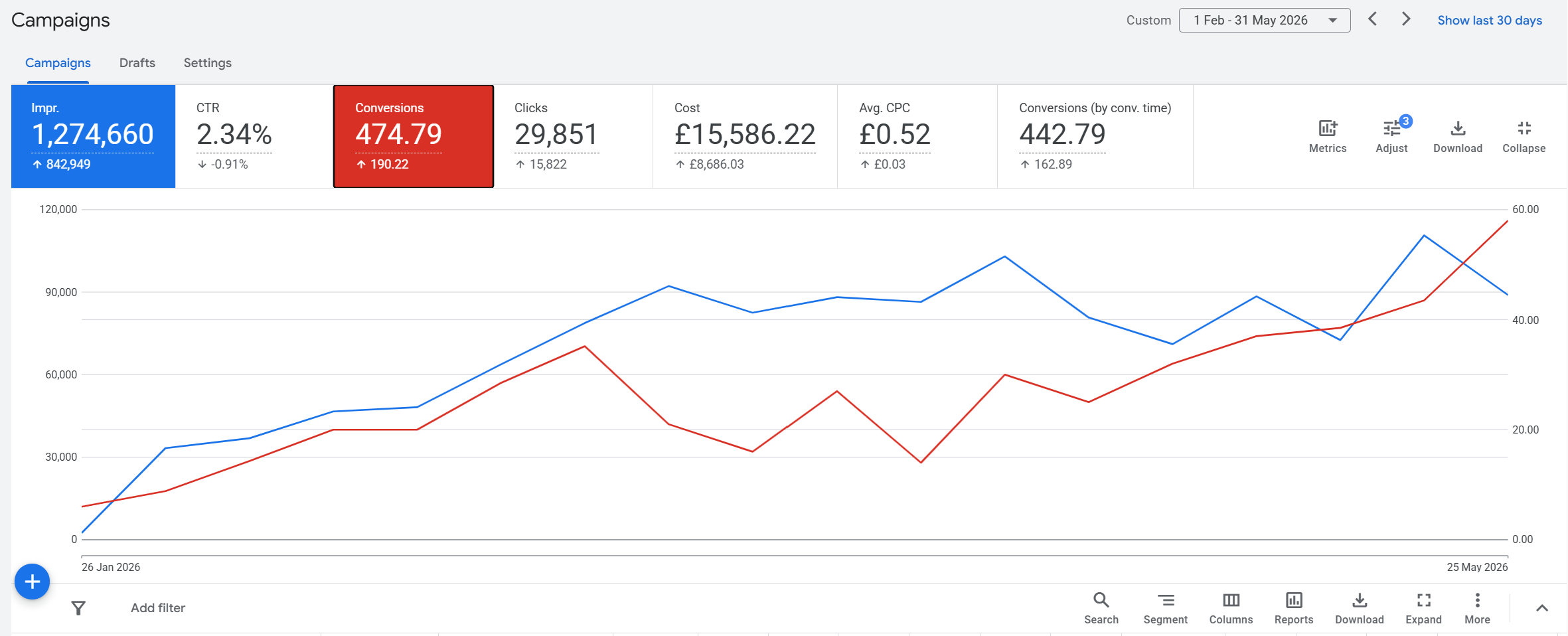
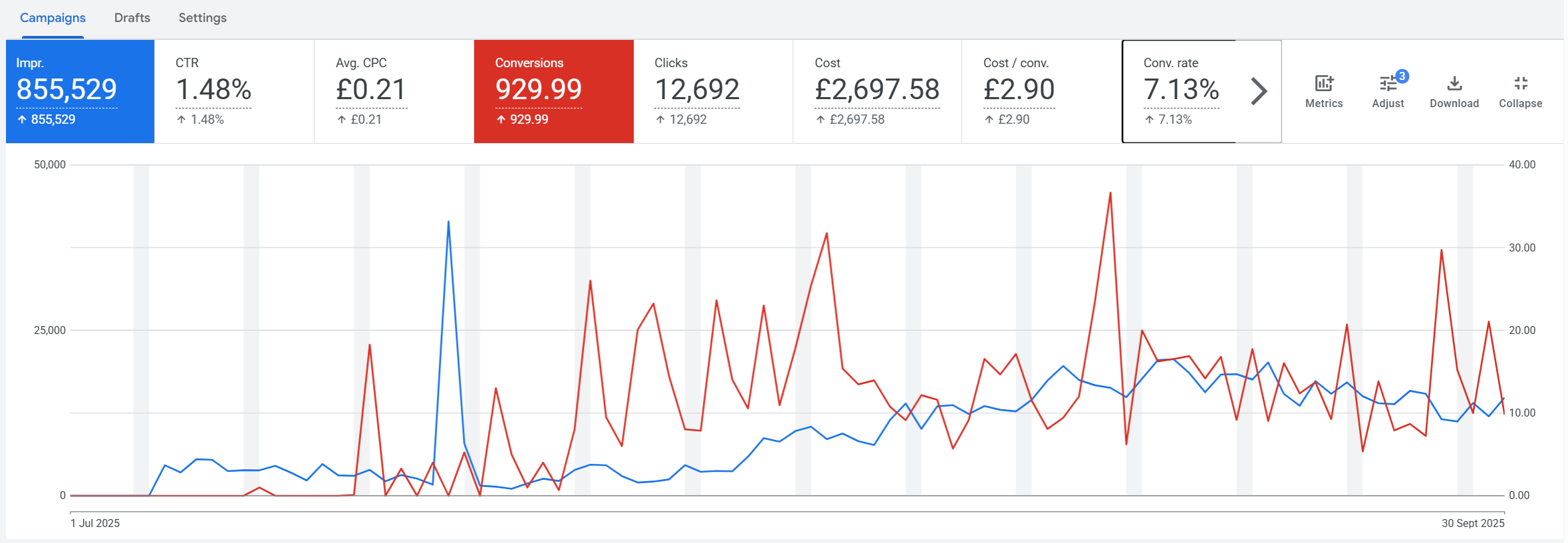
The supplied Google Ads captures cover home services, SaaS and a medical programme. Their periods, clicks and configured conversion metrics remain visible and prominent. The third capture deliberately includes mixed comparison signals: paid-media expertise means diagnosing inefficiency, not presenting every large number as a win.
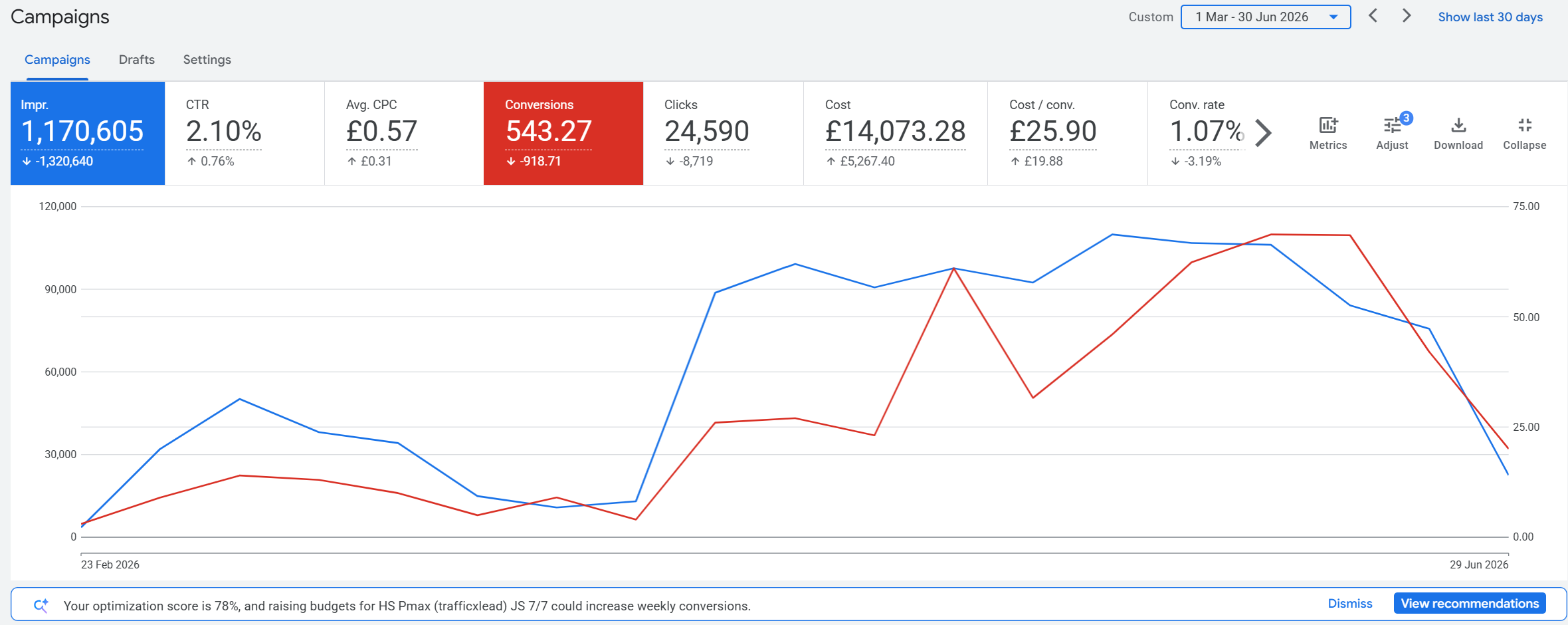
Why this is shown: The comparison indicators are mixed: CTR increased, while clicks and reported conversions fell and cost per reported conversion rose. This capture is presented as evidence of account scale and diagnostic discipline, not as a before-and-after win.
These anonymised Google Ads interface captures show account-reported campaign activity. ‘Conversions’ reflects configured account actions and attribution settings; the captures do not by themselves verify customers, revenue, profitability, sole attribution or future results.
Verified GrowthLabs credentials
We have confirmed that the supplied partner and certification artwork is authorised for GrowthLabs. Each credential is shown in its original supplied form and placed beside the service it supports.

Platform credential
Certified Google Ads Partner credential supplied and confirmed for GrowthLabs.

Platform credential
Certified Meta Ads Partner credential supplied and confirmed for GrowthLabs.

Platform credential
Certified Amazon Ads Partner credential supplied and confirmed for GrowthLabs.
Credentials establish platform familiarity; the adjacent account captures show selected reported performance. Neither replaces a scope-specific audit, current platform verification or an agreed definition of a qualified conversion.
Illustrative flow, not a result promise
The real flow depends on the offer, market, platform, privacy requirements and sales process. This framework explains how the parts can support each other.
Help a relevant but unengaged audience recognise the problem and outcome through focused video, content or a landing page.
Explain fit, method, proof and objections for people who have shown interest, then measure useful page and return behaviour.
Present the offer and reduce next-step friction through an appropriate call, WhatsApp, purchase, booking or enquiry route.
Respond with context and a clear next step, then review contact rate, qualification and the eventual business outcome.
Advertising process
Define the offer, audience, value, margin, sales process, media budget and qualified conversion.
Review accounts, history, creative, landing pages, tracking and lead handling.
Select platforms, audiences or keywords, messages, creative hypotheses, budget, pages and measurement.
Configure campaigns and tracking, review policy-sensitive claims and test every conversion route.
Gather enough data to learn without constant, unstructured changes.
Improve targeting, creative, offer, page and follow-up based on qualified outcomes.
Protect the business objective
The scorecard can include search-term quality, relevant reach, click-through rate, landing-page engagement, conversion rate, cost per qualified action, lead-to-customer rate and revenue or margin where reliable data is available.
Platform-reported conversions should be compared with analytics, business records and lead quality.
Use attribution as a decision aid while acknowledging cross-device, privacy, offline and delayed-conversion limits.
Separate spend from management
Advertising cost normally includes platform media spend, strategy and campaign-management fees, and creative or landing-page production. Tracking, specialist tools and extensive reporting may add scope.
Platform spend is shown separately and normally paid to Google, Meta, TikTok or another confirmed provider.
The proposal reflects platform mix, markets, campaign complexity, creative needs, website condition, tracking and optimisation responsibility.
A digital-performance boundary
Digital performance strategy and suitable Google, Meta and TikTok campaign work, plus connected creative direction, pages, tracking and CRO.
Television, radio, print, outdoor media, large production, influencer networks and offline media buying are not assumed unless explicitly agreed.
Related expertise
Advertising questions
GrowthLabs supports Google Ads, Meta Ads and TikTok Ads, including strategy, targeting or keyword planning, creative direction, campaign structure, retargeting, landing-page recommendations, conversion tracking and optimisation.
GrowthLabs is positioned around digital performance advertising. Television, radio, print, outdoor media, large production and offline media buying should not be assumed unless explicitly agreed.
No. Results also depend on demand, offer, price, competition, budget, creative, website, sales process and customer behaviour. GrowthLabs improves the controllable system and reports what the evidence shows.
No. Media spend should normally be paid to the advertising platform and shown separately from strategy, management, creative and landing-page costs.
Yes. An audit can review structure, keywords or audiences, search terms, creative, tracking, landing pages, budget allocation and lead quality before changes are prioritised.
GrowthLabs can provide performance-creative direction, hooks, scripts, messages, variants and testing plans. Design, filming, editing, talent and production are confirmed in scope.
GrowthLabs provides landing-page strategy, conversion-focused content, design and optimisation, with technical implementation agreed according to the website project.
Share the offer, market, landing page, platform history, approximate media budget, existing tracking and the action you consider a qualified result.
Make paid media easier to trust
Share your active platforms and approximate monthly media budget. GrowthLabs will review the campaign system before recommending where more budget or effort belongs.
No booking maze and no forced package. Use the secure form, WhatsApp, email or call us directly.