GrowthLabsby Rohan Neure

Google Ads agency in Nepal · Search campaigns · Conversion measurement

Google Ads agency in Nepal for paid search built around qualified conversions.

GrowthLabs is a founder-led Google Ads agency in Nepal. The work connects search intent, campaign structure, keywords, negative keywords, responsive search ads, assets, bidding, landing pages and conversion measurement. The goal is qualified business action—not traffic purchased without context.

Send the landing page, target locations, current monthly ad spend, primary conversion, account history and whether tracking has been tested.

Google Ads concept showing campaign monitoring, search advertising and performance signals
Google Ads planning spans demand, search terms, campaign structure, landing pages and reliable conversion signals.

The Google Ads objective

Turn Google search demand into a controlled path from query to ad to landing page to a qualified business outcome.

Answer first / scope

What does a Google Ads agency in Nepal do?

A Google Ads agency plans, builds, measures and improves paid campaigns inside Google Ads. GrowthLabs focuses this page on Google-specific work. The broader advertising-agency page covers Google Ads, Meta Ads and TikTok Ads together.

01

Capture existing demand

Google Search Ads can place a relevant message in front of people actively searching for a product, service or solution. Keyword selection, match types, negatives and location settings determine how controlled that demand remains.

02

Connect the landing experience

The ad should continue into a fast, relevant page that explains the offer, fit, proof, risk and next action. Ad optimisation alone cannot repair a page that fails the searcher's question.

03

Define a useful conversion

A form submission, call, WhatsApp click, purchase or booking is only useful when its definition, value and quality are understood. Primary and secondary actions should not be mixed carelessly.

04

Improve the commercial signal

Search terms, cost, conversion data, lead quality and business outcomes should guide changes to keywords, ads, pages, bids and budget. Platform totals are evidence, not complete commercial truth.

Why Google Ads performance stalls

A campaign can deliver clicks while the commercial path stays weak.

01

Keywords are broader than the offer

Loose keyword selection can buy research traffic, job seekers, support queries, irrelevant locations or needs the business does not serve. Search-term review and negative keywords are continuous controls.

02

Every campaign shares one budget

Brand, non-brand, competitor, location and different service intents can behave differently. Combining them without a reason makes spend and performance harder to interpret.

03

Ads promise what the page does not explain

A high-intent click still needs message continuity, credible proof, clear scope, mobile usability and a suitable action. A generic homepage often leaves too much unanswered.

04

Automation receives weak signals

Smart Bidding can only act on the conversion data and value signals available to it. Duplicate, low-value or unverified events can train optimisation toward the wrong outcome.

05

Lead quality disappears after submission

When qualified, unqualified and unreachable leads all look identical in the account, campaign decisions can reward volume that the sales process does not value.

06

Changes happen without a testable reason

Frequent bid, budget, keyword, ad and page changes can erase the learning trail. Every material change should have a hypothesis, sufficient observation and a clear decision rule.

Google Ads services in Nepal

Control the query, campaign, page and measurement system.

01

Google Ads account audit

Review account access, campaign types, settings, history, search terms, keywords, ads, assets, locations, audiences, bidding, budgets, conversions and landing pages before prescribing a rebuild.

  • Account structure
  • Settings and history
  • Waste and risk review
  • Priority actions

02

Keyword and search-term strategy

Map commercial search intent to the offer, choose responsible match types, organise themes and maintain negative keywords using the real queries that trigger ads.

  • Intent mapping
  • Match-type choices
  • Negative keywords
  • Search-term review

03

Campaign architecture

Separate campaigns and ad groups where budget, geography, intent, service, brand or measurement needs a distinct control—without creating needless fragmentation.

  • Campaign roles
  • Ad-group themes
  • Location controls
  • Budget boundaries

04

Ads and assets

Write responsive search ads and supporting assets that answer the query, qualify the offer and continue naturally into the selected landing page without unsupported promises.

  • Message strategy
  • Responsive search ads
  • Assets
  • Policy-aware claims

05

Landing-page alignment

Review page relevance, hierarchy, offer clarity, proof, mobile speed, calls to action and post-enquiry expectations so paid search has a credible destination.

  • Message match
  • Offer clarity
  • Mobile journey
  • Conversion friction

06

Conversion tracking and lead quality

Define primary and secondary actions, implement or review Google Tag Manager and GA4 signals, test duplicate controls and connect lead-quality feedback where the business can support it.

  • Conversion definitions
  • GA4 and Tag Manager
  • Event validation
  • Lead-quality feedback

07

Bidding and budget control

Choose bidding and budget logic according to data maturity, commercial value, demand and risk. Automation is used as a tool, not as a substitute for valid inputs.

  • Bid strategy
  • Budget allocation
  • Data readiness
  • Change control

08

Optimisation and reporting

Review queries, impression and click delivery, cost, configured conversions, landing behaviour and qualified outcomes, then document what changed and why.

  • Search-term quality
  • Cost and conversion context
  • Landing-page learning
  • Next actions

What disciplined PPC management creates

Better information for the next budget decision.

01Cleaner search-intent control

02Stronger ad-to-page continuity

03Tested conversion definitions

04Budget decisions tied to qualified outcomes

Google Ads evidence / supplied account captures

Three Google Ads accounts, with the visible numbers and context left intact.

The supplied captures show separate home-services, SaaS and medical-programme accounts across their stated reporting periods. They provide inspectable evidence of account scale, clicks, cost and configured conversion data. The medical capture includes mixed comparison signals, so it is presented as diagnostic context rather than a success claim.

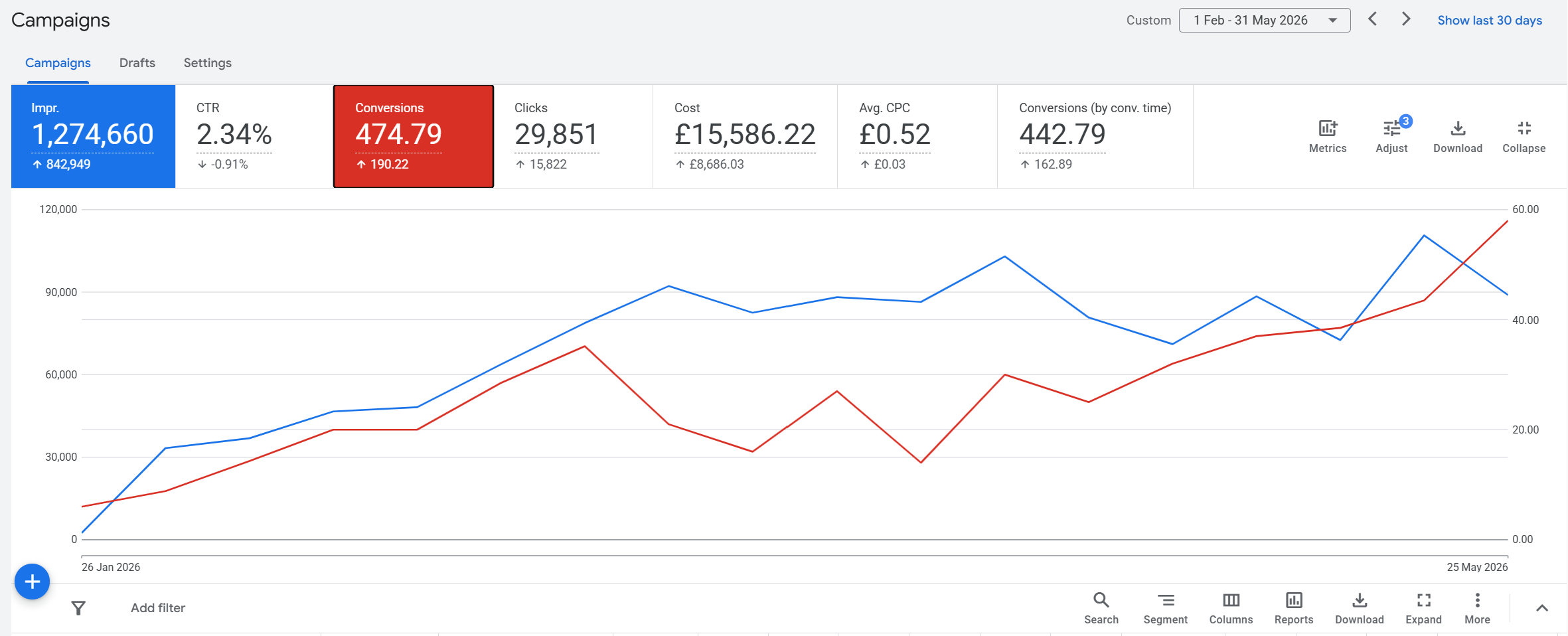
Google Ads performance view showing 1.27 million impressions, 29,851 clicks and 474.79 reported conversions from February to May 2026
01 / Google Ads / London home-services account · 1 Feb–31 May 2026View source ↗
impressions
1.27M
clicks
29,851
reported conversions
474.79
average CPC
£0.52
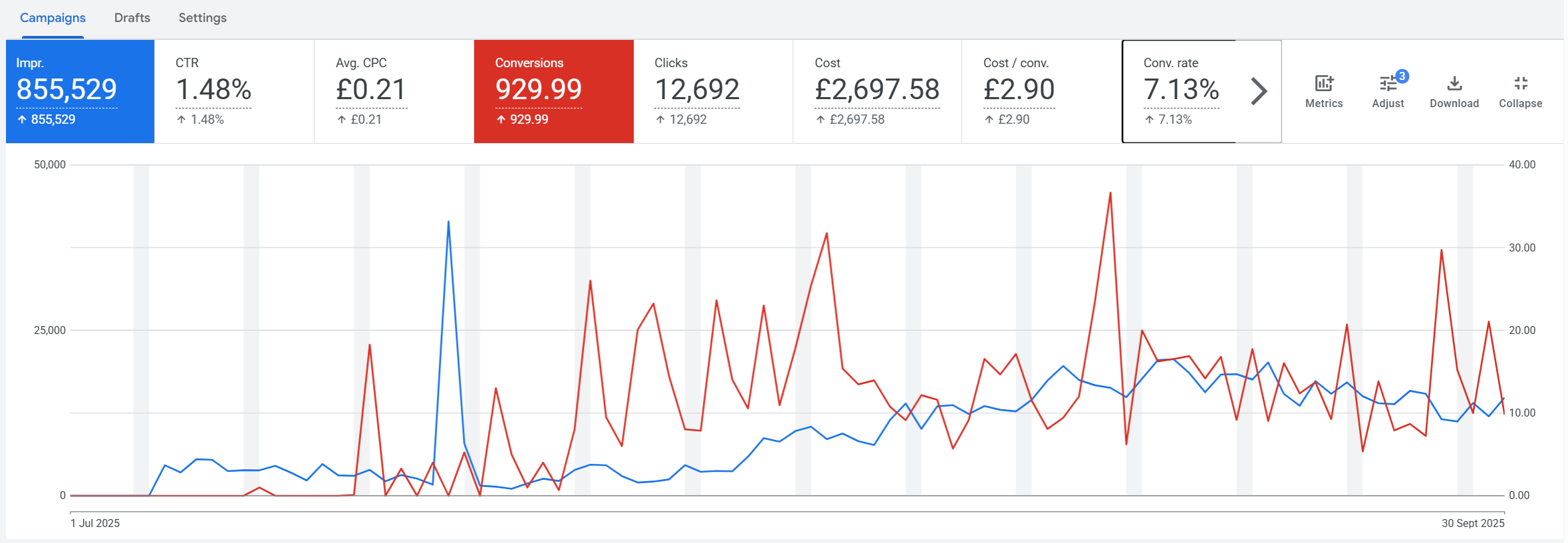
Google Ads performance view showing 855,529 impressions, 12,692 clicks, 929.99 reported conversions and £2.90 reported cost per conversion from July to September 2025
02 / Google Ads / SaaS account · 1 Jul–30 Sep 2025View source ↗
impressions
855K
clicks
12,692
reported conversions
929.99
reported cost / conv.
£2.90
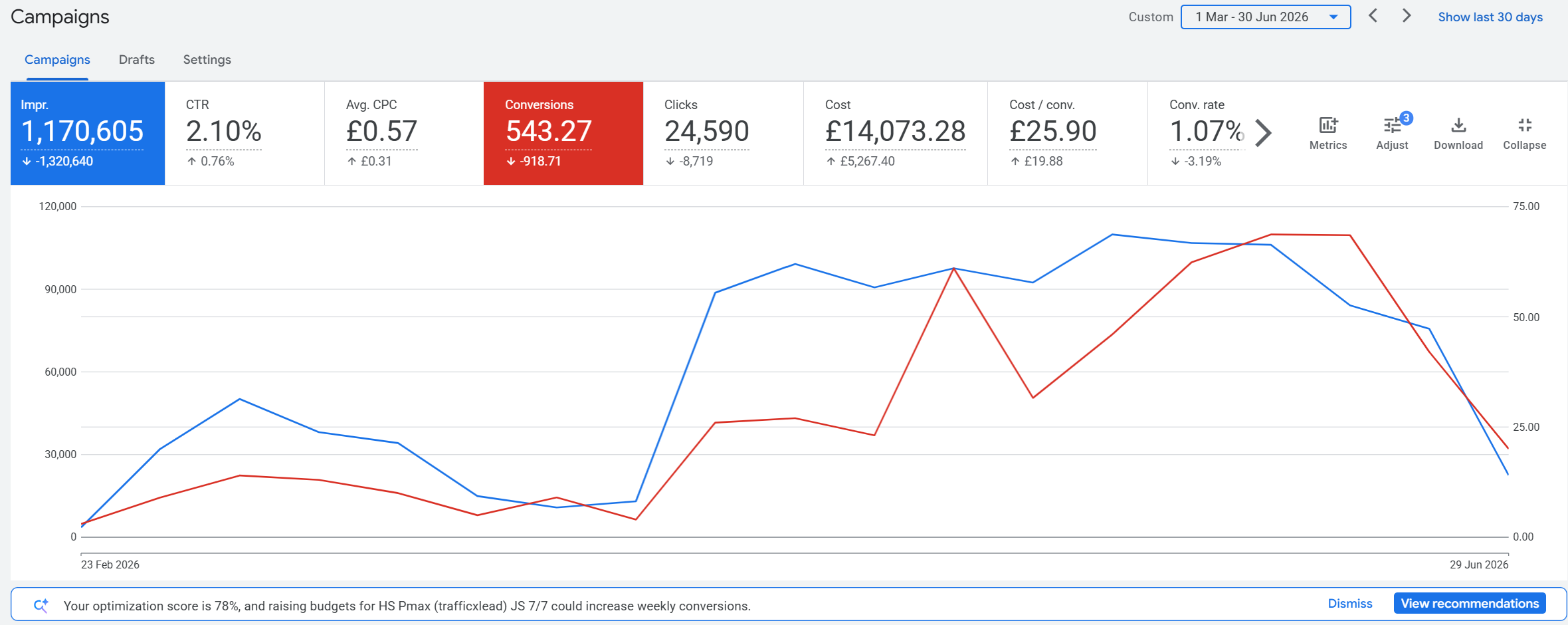
Google Ads performance view for a UK medical programme showing 1.17 million impressions, 24,590 clicks and 543.27 reported conversions from March to June 2026
03 / Google Ads / UK medical-programme account · 1 Mar–30 Jun 2026View source ↗
impressions
1.17M
clicks
24,590
reported conversions
543.27
reported cost / conv.
£25.90

Why this is shown: The comparison indicators are mixed: CTR increased, while clicks and reported conversions fell and cost per reported conversion rose. This capture is presented as evidence of account scale and diagnostic discipline—not as a before-and-after win.

These anonymised Google Ads interface captures show account-reported campaign activity. ‘Conversions’ reflects configured account actions and attribution settings; the captures do not by themselves verify customers, revenue, profitability, sole attribution or future results.

Fit and qualification

Google Ads works best when the demand, offer and response path are real.

Paid search can capture active demand quickly, but it does not create product-market fit or guarantee profitable volume. The first review qualifies what Google Ads can reasonably influence.

01

Useful fit

The business has a defined offer, a target market, some relevant search demand, capacity to respond and a measurable action such as a qualified call, enquiry, booking or purchase.

02

Weak starting fit

The offer is unclear, the economics cannot support acquisition cost, the page is not usable, nobody can follow up or the desired audience is not expressing suitable search demand.

03

Lead generation

Service businesses can measure calls, forms, WhatsApp actions and downstream lead status when access and sales feedback allow. A raw lead count should not replace qualification.

04

Ecommerce and value

Retail campaigns require reliable product information, pricing, fulfilment, purchase tracking and commercial margin context. Revenue data still needs returns, cancellation and profit awareness.

Source-capture context

Read Google Ads evidence without turning platform totals into invented revenue.

Three supplied screenshots are shown on this page. Each retains its reporting period and visible interface metrics. Configured conversions are reported as configured account events—not independently verified customers, sales or return on ad spend.

01

London home services account

The 1 February–31 May 2026 capture reports 1,274,660 impressions, 29,851 clicks, £15,586.22 cost, £0.52 average CPC and 474.79 configured conversions.

02

SaaS account

The 1 July–30 September 2025 capture reports 855,529 impressions, 12,692 clicks, £2,697.58 cost, £0.21 average CPC and 929.99 configured conversions.

03

UK medical-programme account

The 1 March–30 June 2026 capture reports 1,170,605 impressions, 24,590 clicks, £14,073.28 cost and 543.27 configured conversions. Its comparison indicators are mixed, so scale is not presented as a win.

04

What the captures support

They support a discussion about Google Ads account scale, efficiency signals, configuration and diagnosis. They do not prove your future result or disclose the full economics of any represented business.

Google Ads management process

Audit first. Build or repair with evidence.

  1. 01

    Qualify

    Clarify the offer, locations, audience, economics, media budget, sales process and definition of a qualified conversion.

  2. 02

    Audit

    Inspect the account, history, queries, settings, ads, pages, tracking and available lead-quality evidence.

  3. 03

    Map

    Connect search intent to campaign roles, keyword themes, ads, landing pages, exclusions, budgets and measurement.

  4. 04

    Build and validate

    Create or repair campaigns, test conversion routes, review policy-sensitive claims and document launch settings.

  5. 05

    Launch with control

    Protect the initial learning period from unnecessary changes while watching spend, relevance, errors and query quality.

  6. 06

    Optimise

    Use sufficient evidence to improve search terms, bids, budgets, ads, pages and qualification, then record the next hypothesis.

Measurement definitions

Count the action, then test whether the action matters.

Google Ads, GA4, the website and the sales process can each describe a different part of the journey. Reporting should reconcile what can be reconciled and state what remains uncertain.

01

Primary conversions

Actions used for core bidding and performance decisions, such as a verified purchase, qualified enquiry, booked consultation or another agreed high-value event.

02

Secondary conversions

Useful diagnostic actions such as engaged visits, key page views or preliminary contact clicks. These should not silently carry the same meaning as a completed business outcome.

03

Attribution limits

Consent, cross-device activity, delayed decisions, offline sales and model differences mean no platform sees every journey perfectly. Attribution should guide decisions without pretending to be exact truth.

04

Lead-quality loop

Where the business can classify enquiries, campaign reporting should compare volume with relevance, contactability, qualification and eventual outcome—not stop when a tag fires.

Scope and Google Ads fees

Separate media spend, management and production.

Google Ads pricing depends on account condition, campaign types, markets, keyword breadth, media spend, tracking, landing-page needs and reporting responsibility. A scoped proposal explains each cost before work begins.

01

Media spend

Advertising budget is normally paid directly to Google and remains separate from GrowthLabs strategy or management fees.

02

Management scope

The fee can cover audit, planning, build, monitoring, search-term work, ads, budget control, testing, reporting and agreed communication.

03

Implementation scope

Landing-page writing or development, advanced tracking, feeds, call systems, creative production and specialist tools are confirmed separately when needed.

04

Account ownership

The client should retain appropriate ownership and administrative access to the Google Ads account, analytics properties and business data used for the engagement.

Google Ads agency questions

Direct answers about accounts, fees, proof and expectations.

01What does a Google Ads agency in Nepal do?

A Google Ads agency audits, plans, builds, tracks and improves campaigns in Google Ads. GrowthLabs connects keywords and search terms with campaign structure, responsive search ads, assets, bidding, budget, landing pages, GA4, Tag Manager and qualified conversion feedback.

02How is this different from the advertising agency page?

This page focuses specifically on Google Ads and paid search management. The advertising agency in Nepal page covers the wider paid-media system across Google Ads, Meta Ads, TikTok Ads, performance creative, retargeting and multi-platform landing journeys.

03Can GrowthLabs audit an existing Google Ads account?

Yes. An account review can examine settings, campaign structure, keywords, search terms, negatives, ads, assets, locations, audiences, bids, budgets, conversions and landing pages. Access level and review depth are agreed before work starts.

04Does GrowthLabs guarantee Google Ads leads or sales?

No. No responsible Google Ads agency can guarantee a lead, sale, cost per acquisition or return. Results also depend on demand, competition, offer, price, budget, website, tracking, sales follow-up and customer behaviour.

05How much should a business spend on Google Ads in Nepal?

There is no responsible universal minimum. Budget should reflect relevant search demand, click-cost ranges, geographic coverage, conversion value, learning needs and business capacity. GrowthLabs recommends a range only after understanding the market and objective.

06Is Google Ads spend included in the agency fee?

No. Media spend is normally paid directly to Google. Strategy, campaign management, tracking, landing-page work, production and specialist tools are scoped separately so the business can see where the investment goes.

07Who owns the Google Ads account?

The client should retain appropriate ownership and administrative access. GrowthLabs requests the access needed to perform the agreed work; it does not require the client to surrender ownership of its advertising or analytics data.

08Can you set up Google Ads conversion tracking?

Yes. Scope may include conversion definitions, Google Tag Manager, GA4 and Google Ads event implementation or review, consent-aware validation and duplicate-event checks. CRM or offline conversion integration depends on the systems and access available.

09How soon can Google Ads produce results?

Ads can begin delivering after approval and launch, but useful evaluation takes sufficient search volume, spend and conversion evidence. Timing varies by market, account history, budget, tracking and sales cycle. Early clicks are not proof of sustainable performance.

010What should I send for a Google Ads review?

Send the website or landing page, target services or products, locations, current account status, approximate monthly media spend, primary conversion, tracking setup and any available information about lead quality or sales outcomes.

Founder-led Google Ads review

Find the constraint before putting more budget behind it.

Share the landing page, target market, current account status and approximate monthly media spend. GrowthLabs will review whether search intent, structure, ads, page experience, tracking or lead quality deserves attention first.

No form. No booking link. Message, email or call Rohan directly.